

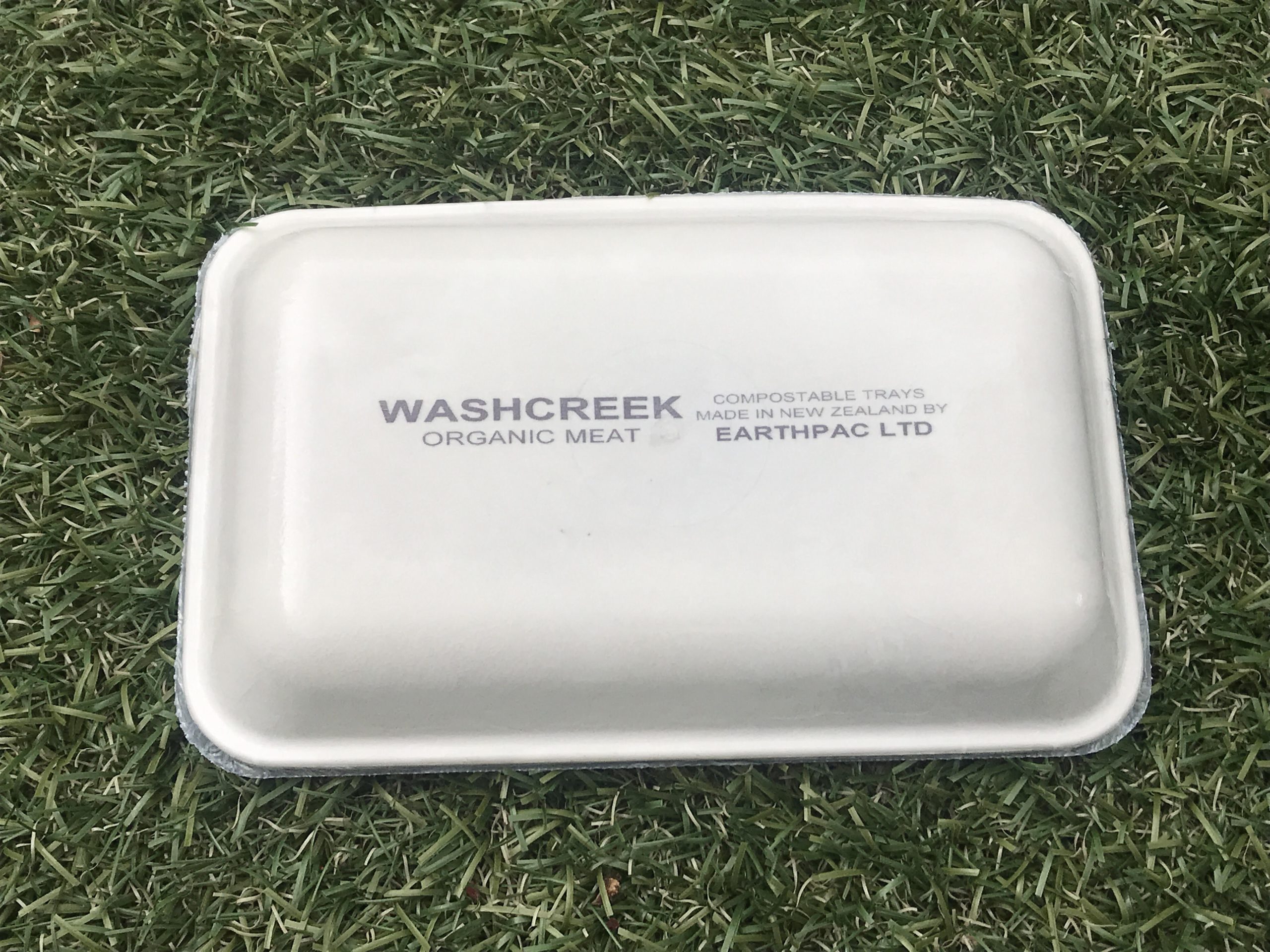
Earthpac’s new 100% compostable meat trays
22 November 2018
Case Study: Auckland District Health Board, New Zealand
GGHH Agenda Goals
- Waste
Hospital Goal
- Reduce Plastic Waste
Progress Achieved
- Savings, since the compostable drug trays are cheaper than the plastic trays
- The compostable drug trays are made in New Zealand using over 85% renewable energy
- From a New Zealand owned company, providing employment to the community and giving profits back into the New Zealand economy
- Waste reduction: The compostable drug trays are made from a by-product of an existing process
- The compostable trays do not require a dedicated composting waste stream for disposal and will rapidly decompose in the natural environment
- The compostable trays do not burden the environment with micro plastics and plastic micro-fibres, which are accumulating in drinking water and the marine environment
- The manufacturing process is actually carbon negative (one 25g tray sequesters the amount of CO2 contained in 110m3 of atmosphere)
The Issue
Patient safety by maintaining a highly sterile environment in operating rooms is paramount. However, it also promotes a culture of single use disposable medical products and packaging resulting in increased waste volumes1. Based on Australia study, the waste generated by operating rooms accounts for between 20-30% of all hospital waste and 40% of this waste is potentially recyclable2.
The anesthetists at Auckland DHB (Auckland DHB) have been at the forefront in driving sustainability, changing culture and practice in operating rooms (OR) as well as other areas business. Their clinical expertise, a deep sense of responsibility for the environment have resulted in a number of new initiatives and earned this group of highly motivated team considerable respect and gratitude from service managers across the organisation..
One such initiative led by the anesthetists was the use of hard plastic drug trays used both in OR and ward setting. Approximately 175,000 plastic drug trays annually were being used across Auckland DHB. Whilst the trays could be recycled, most were not being disposed of appropriately and sent directly to landfill.
The Women’s Health OR team wanted to move away from single use plastic and identified a suitable, 100% compostable alternative from potato starch by earthpac™.
Sustainability Strategy Implemented
The hospital covers 316,000 m2 of floor space with approx. 1500 beds and 42 operating rooms the Auckland District Health Board (DHB) it is one of the largest health service providers in New Zealand delivering services to over one million patients per annum. It is a high end user of water, air travel, transport, procurement, pharmaceuticals and waste. The Board has a deep sense of responsibility towards its community in health prevention and protecting the environment for future generations.
It prides itself as being a socially responsible organisation and since 2015 has been driving an active sustainability programme in its commitment to reduce the environmental footprint through energy efficiencies, waste minimisation, innovation, technology, education, and a change in culture that embraces sustainable practice.
Implementation process
The Women’s Health OR team conducted considerable research into alternative drug tray that reduced emissions and minimized the environmental impact. They made enquiries concerning materials, manufacturing processes, security of supply, transport and end of life/disposal.
A locally made product was identified manufactured in NZ made from potato starch and 100% compostable. The manufacturer supplied the sample product for the pilot. The OR team tested the drug tray in the live environment and found the product suitable for an initial pilot. Other OR services were informed of the pilot and were also included in the pilot study. The 3 OR services involved in the pilot study were Women’s Health, Children’s Health & Adult Services, involving 22 out of 42 theatres. The teams agreed to meet regularly to discuss the products applicability and robustness within the OR setting.
The supplier was informed on progress and further modifications of the drug tray were made to replicate the existing plastic drug tray.
Tracking Progress
No adverse patient risk was identified nor was there any impact on the sterile environment within the theatre from the use of the earthpac™ product. The drug tray met the clinical requirements within the OR and all clinical teams who were included in this pilot endorsed the earthpac™ product as being a suitable alternative to the plastic drug tray.
Post implementation monitoring of the earthpac™ products show a greater up-take in ORs but intermittent throughout wards and other clinical teams. This was attributed to order clerks not being aware of alternative earthpac™ option. Further engagement was undertaken and this resulted in the hard plastic trays being delisted from the product catalogue list and the earthpac™ product being the first item of choice.
Challenges and lessons learned
Sustainability is an interdisciplinary matter which should be assessed from all possible perspectives - from energy, water, and materials used in manufacturing to where the product ends up after its end of life use. Working with the manufacturer, supplier, waste provider and processor helps build trust, identify solutions and a more unified approach that will protect the patients, our wider community and our environment.
Small ideas that lead to change in practice can have massive positive impact when implemented in large hospitals like Auckland DHB. These types of ideas can in turn have impressive positive impacts for our environment.
Positive engagement and encouraging sustainability champions to lead initiatives not only strengthen the bonds between colleagues that create a shared vision and goal but also provide opportunities for research, sharing knowledge and expertise across different disciplines that are exist within a hospital setting.
Next Steps
450 characters max.
The earthpac™ drug tray was evaluated by all three OR teams for fit-for-purpose, functionality and handling of the tray during normal OR procedures. The findings revealed the earthpac™ tray met all criteria with no variability in function, durability or clinical safety when compared with the plastic tray. The findings were presented to various clinical product coordinators and Product Management Committee responsible for determining clinical-related product. The OR teams gave a recommendation that the organisation replace plastic drug trays with earthpac™ drug trays.
The recommendations were accepted and the hard plastic tray has now been removed from the product catalogue to be replaced by the earthpac™ product as the preferred procurement option.
This initiative has prompted other teams to put forward proposals for other pilots that reduce the impact on the environment. These include the food & paper towel waste composting streams, reprocessing plastic syringes and a project to improve recycling in ORs.
The Demographic information
As one of the largest healthcare providers in New Zealand, we have two main hospitals spread over two campuses, numerous community sites with approximately 1,500 beds and 11,000 staff. It is the provider of healthcare services to approximately 1 million patients per year with approximately 1,500 beds and about 11,000 staff. The NZ population is diverse with a high Māori, Pacific Island and Asian population, growing and aging (65+). The Board serves a local population of 530,000 residents and provides specialist treatment to people from other parts of New Zealand and Pacific Islands. It is a teaching hospital with a major academic facility.
Quotes:
Please share a few key quotes from stakeholders involved in this process.
Contacts & Acknowledgements
Main contact person information: Manjula Sickler, Sustainability Manager, Auckland District Health Board; Email: Mark@earthpac.co.nz Telephone number: 021 948808
The Auckland District Health Board wishes to acknowledges the following for their valuable contribution and support for this pilot;
- Dr Arend Merrie, Director Surgical Services, Colorectal Surgeon
- Dr Vanessa Beavis, Director of Perioperative Services, Auckland City Hospital
- Wendy Guthrie, OR Manager / Nurse Leader, Adult & Emergency Level 8 Theatres
- Dr Felicity Pugh, Specialist Anaesthetic, Level 8 theatres
- Stephanie Guo, Clinical Nurse Educator, Level 8 Theatres
- Ngaire Sharp, Theatre Manager, Greenlane Surgical Unit
- Dr Martin Minehan, Deputy Clinical Director of Anaesthesia, Women’s Health
- Judith Bruges, Midwife, Ward 91 Delivery Suite, Women’s Health
- Peter Melville, Charge Midwife, Ward 91 Delivery Suite, Women’s Health
- Neil Browne, Operations Manager, Non Clinical Support Services
- Bob Ndungu, Waste Co-ordinator, Non Clinical Support Services
Oracle codes
318629 Hospital Tray317924 Large Medical Tray
346724 Deep Tray


